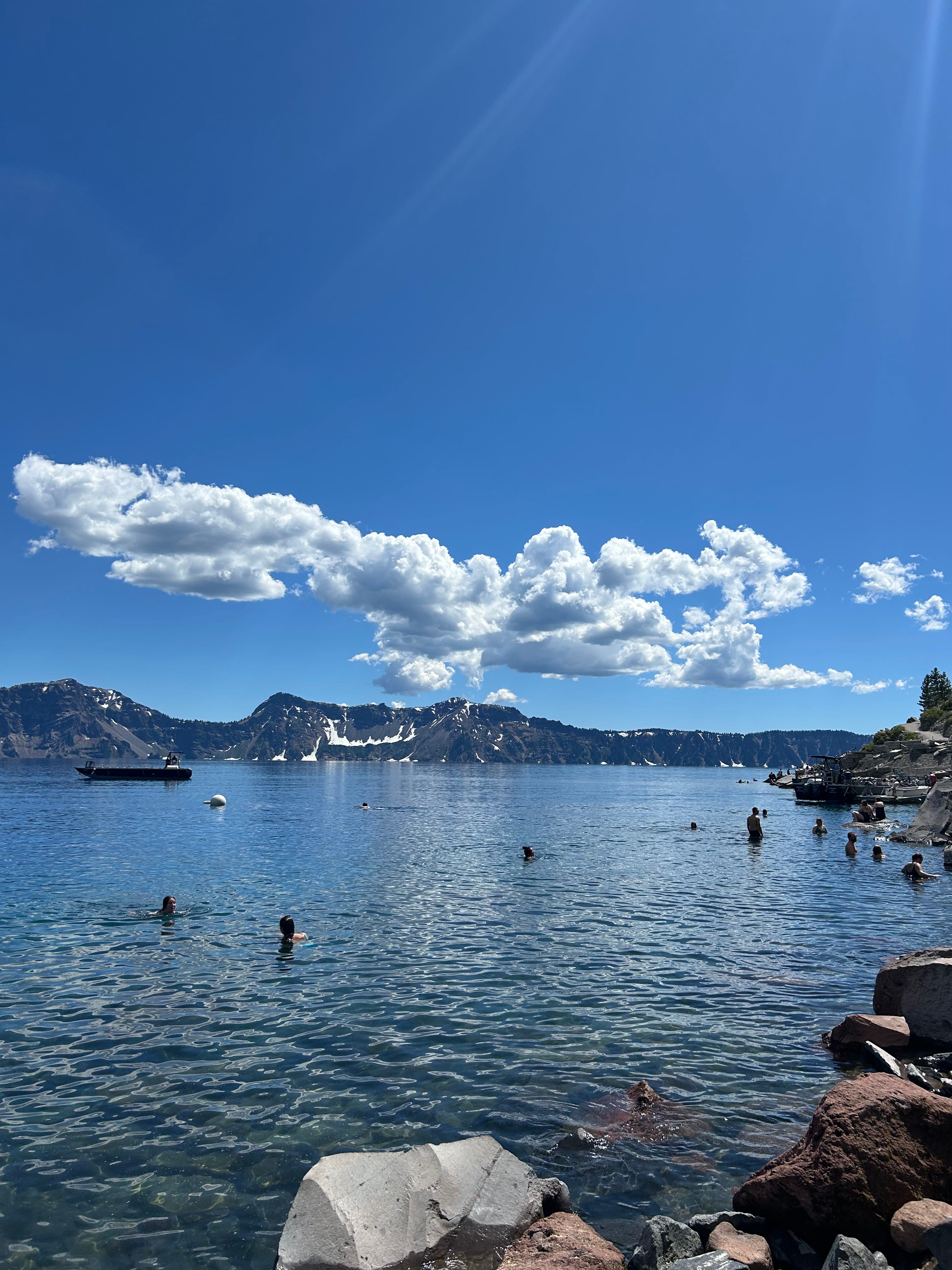
Swimming Pool Surrounded by Fire
An excerpt from an essay I'm working on about swimming lessons, the cognitive dissonance of parenting right now, and summer misadventures.

I think my biggest joy in the summer is jumping into various bodies of water. I’ve come to yearn for my weekly cold plunge. It seems to reset my mind and body in a way nothing else can. In the summer, Portland transforms from a rainy city into practically a beach town. We have swim spots along the Columbia and Willamette Rivers, on the alpine lakes of Mount Hood, and in Crater Lake, Oregon’s only National Park, where, unfortunately, our car recently broke down on our big camping trip of the summer.
Due to repairs on the lake access trail, 2025 was going to be the last year to swim in Crater Lake until 2029, so we simply had to go check it out (I’d never been) and swim. My family and I were halfway around the Rim Trail in Crater National Park when the battery light in our Kia Sorento came on. We’d just finished a strenuous hike back up from Cleetwood Cove—where we’d swam in the cold and clear bluest of blue water of Crater Lake—and were driving toward our campground in the Mazama Village to meet some family. Hopefully nothing I thought, regarding the light. But then every single light on the dashboard came on. The power steering went out as we crept through the campground until, finally, not yet to our campsite, the car just died next to the campground bathroom. We got a jump and the car sputtered for another thirty or so feet before dying again. The car was ten years old, but it wasn’t like, an old car. And I mean, not the worst place we could breakdown? At least we’d made it to the campsite, right?
Crater Lake is the deepest lake in North America and could possibly be the cleanest lake the in the entire world. Well, there’s a reason for that. It’s remote as hell. The closest city is Klamath over 60 miles away, or Medford, 72 miles and 1.5 hours away. Portland, where we came from, is over 5 hours. If I had to pick a place to breakdown, Crater Lake National Park might be one of the last on the list. It is beautiful though.

I had to walk fifteen minutes to the general store at the campground for a Wi-Fi signal. Normally, not a bad thing. A great thing! I come out to the outdoors to get unplugged. To stop scrolling through my phone reading about the world wars about to start and the political corruption and everyone’s Instagram feeds showing them in Amsterdam or Australia, Hawaii or Italy.
But when you have to deal with an emergency—no phone or internet search options for the closest auto repair shop—no cell service is a little less than ideal. Things just aren’t set up anymore for the analog world of phonebooks and payphones. So rather than a three-day camping trip in Crater Lake, we spent one and a half days in Crater Lake, and two or three days in Medford. While at the hotel I reached a place of paralysis, where all I could seem to do was doomscroll. Doomscroll on the phone and take the kids to the hotel swimming pool. We also played mini golf one day and took a Lyft to a movie theater to pass the time while our car was in the shop.
At the end of our trip, driving up north on I-5, I asked in a sort of joking manner what my daughters’ favorite part of our trips was. They exclaimed without missing a beat. “The pool!”
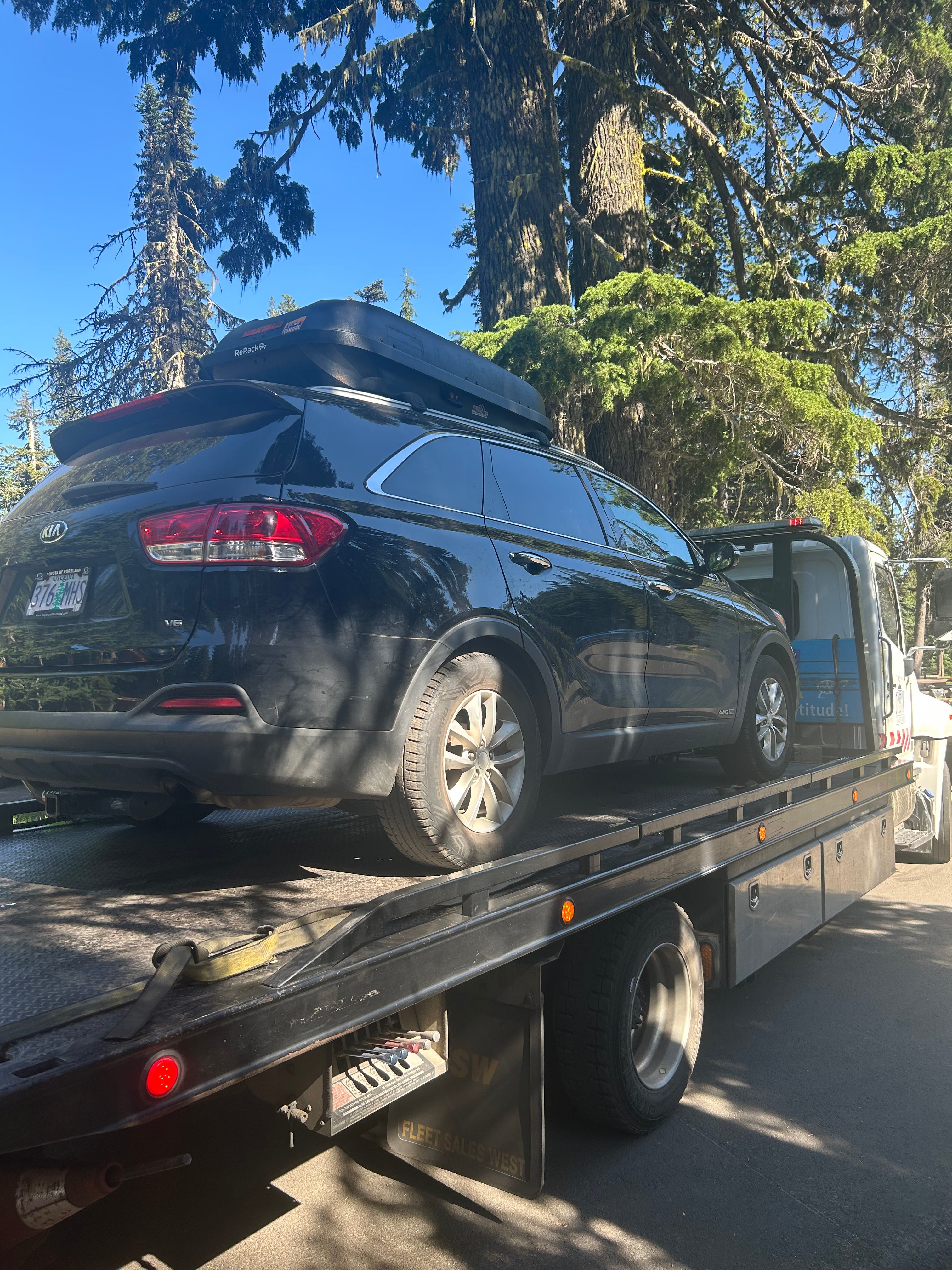
The car trouble set an adverse tone for the summer of 2025 I couldn’t escape. It became hard to focus on the positive. Everywhere I looked the world seemed to be on fire. My wife Cat says I have a tendency to focus on the negative. As a depressive person, I know this is to be terribly true and so I try to remember that not everything has been horrible. Our family has gone on many wonderful camping trips and explored the beach and made memories at parks and zoos and islands and mountains this summer. But not everything in the world is peachy right now.
I’m not sure anything from the last five years has imprinted on my children as much as it has on me or as it has on our teenagers and Gen-Z. My children are young enough they will likely forget any of this. My children will probably be fine, unlike the 20,000 children who have been killed in Gaza in just the last two years. So much is out of our control. So much of it is luck.
“Giving your kids a normal, healthy childhood is part of the resistance,” a friend tells me. But is that true?
It is a harsh reality to state straight at these atrocities and collapses of our society. Sometimes they seem too much to bear. I understand the tendency to brush off or dismiss or not want to engage with the state of the world. Our minds are not made for the onslaught of this techno-media landscape that conveys information and disaster faster than our brains can process it (all while tech companies profit from it). I know many people are already in the trenches, like my own wife, a social worker, who only wants to come home and read some multi-volume novel about faeries or some fantastical shit.
Perhaps this is constant state of the world—everyone feeling like the end is nigh. Every generation with their own struggle and apocalypse.
So rather than four days in Crate Lake, we spent 1.5 days in Crater Lake and 2.5 days in Medford, Oregon. Yet another thing to put on the credit card and hope to pay off.
Maybe that’s what history/the nature of life is. Two steps forward, one step back. Then one to the left, one to the right, and one more forward, two back again. This is the messy truth of humanity. Or perhaps it’s as Susan Sontag once said that: “10 percent of any population is cruel, no matter what, and 10 percent is merciful, no matter what, and the remaining 80 percent can be moved in either direction.” And unfortunately, there’s always going to be that minority who seek absolute power, wealth, and control. But there’s also that minority constantly cleaning up the broken glass and putting out the fires.
So I think, what can I do right now in this moment? What does my family need from me? My immediate community? My neighborhood? Focus on that. Build slow and small. Let the water hold you for a moment.